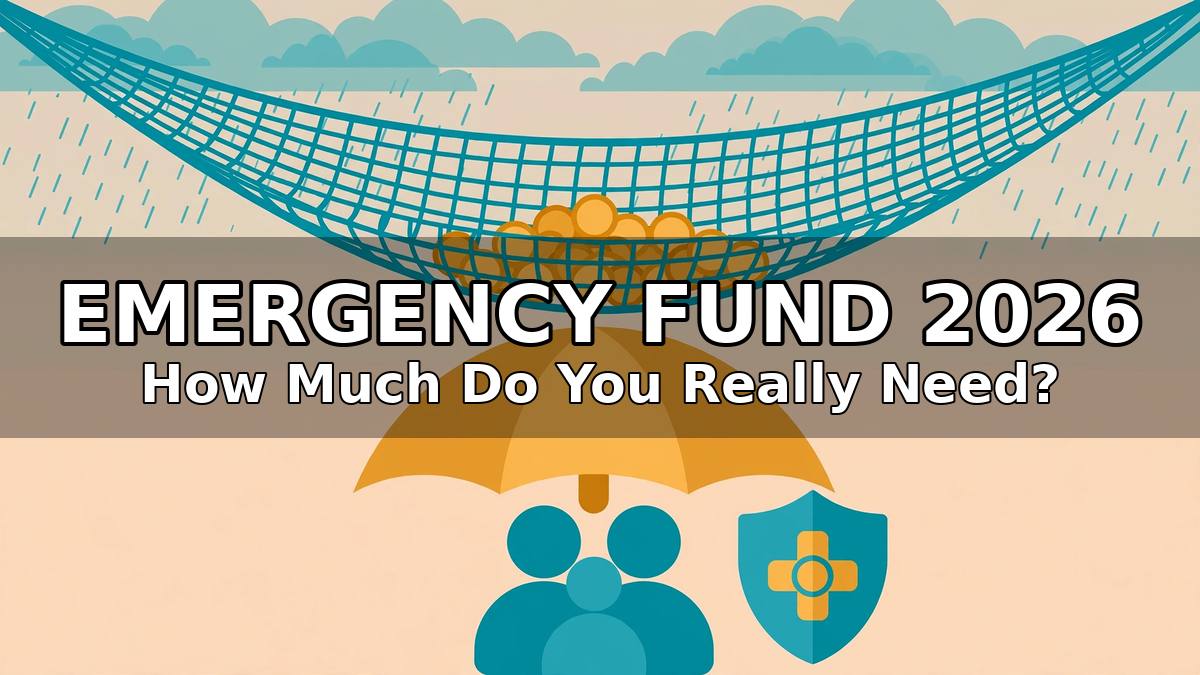
Your car needs a $600 repair. Your fridge dies the same week. Then your hours get cut at work. This is exactly what an emergency fund 2026 plan is for.
Without savings, one bad month like this becomes debt — credit cards, payday loans, borrowing from family. With savings, it is just an annoying week. That is the entire point of an emergency fund: it turns financial emergencies into inconveniences.
Yet most advice about emergency fund 2026 is vague (“save 3-6 months of expenses!”) and feels impossible when you are starting from zero. Let us make it concrete.
What Counts as an Emergency?
Before the numbers, the definition matters — because raiding your emergency fund for non-emergencies is the number-one reason they fail.
An emergency fund 2026 is for unexpected, urgent, necessary expenses:
- Job loss or a sudden drop in income
- Medical or dental bills you did not plan for
- Urgent car repairs (if you need the car for work)
- Essential home repairs (a broken furnace, a burst pipe)
- Emergency travel (a family crisis)
It is not for: holidays, sales, a new phone, concert tickets, or “I deserve it” purchases. If you can plan for it, schedule it, or live without it — it is not an emergency. Write this definition down — it protects your emergency fund 2026. You will thank yourself later.
Common emergency fund mistakes:
- Counting a credit card limit as your safety net. A card is borrowed money at high interest, available exactly until the lender decides otherwise. A fund you own cannot be frozen, cut, or charged interest.
- Basing the target on your full lifestyle budget. Include restaurants and subscriptions and the target balloons until it feels impossible — and impossible targets get abandoned. The fund only needs to cover survival expenses.
- Never recalculating after life changes. A fund sized for a single renter does not fit a new baby, a move to a pricier city, or a switch to freelance work. Recheck the number after every major change, not just once a year.
- Keeping the rules in your head only. If a partner shares the account but not the definition of “emergency,” the fund gets spent with the best intentions. Write the definition down and agree on it together.
Emergency Fund 2026: How Much Do You Actually Need?
The standard advice for an emergency fund 2026 is 3 to 6 months of essential expenses. In 2026, with prices where they are, here is how to translate that into your number:
Step 1: Calculate your monthly survival number. Not your full budget — just the non-negotiables: rent or mortgage, utilities, groceries, transport to work, insurance, minimum debt payments. Leave out dining out, subscriptions, shopping, and entertainment.
Say your survival number is $2,200/month.
Step 2: Pick your multiplier.
- 3 months ($6,600) — enough if you have a stable job, dual incomes, or could find work quickly.
- 6 months ($13,200) — the right target if you are self-employed, freelance, work in an unstable industry, or are the only earner in your household.
- Start with 1 month ($2,200) — if you have nothing saved, this is your first real goal. One month of breathing room changes everything psychologically.
The honest answer for most beginners building an emergency fund 2026: aim for 3 months, start with $1,000, then build to 1 month of breathing room. The perfect target you never reach is worth less than the imperfect one you actually build.
Where to Keep Your Emergency Fund 2026 (This Matters More Than You Think)
Your emergency fund needs two properties: accessible within a day or two, and separate from your spending money.
The best home for it is a separate high-yield savings account at a different bank from your checking account. In 2026, these pay meaningful interest while your money sits ready. The “different bank” part is deliberate — a little friction stops impulse raids, while online transfers still get you the money in 1-2 business days.
Do not keep your emergency fund in:
- Your checking account — it will quietly get spent.
- Cash at home — no interest, and it is vulnerable to theft, fire, and “just this once” borrowing.
- Investments or crypto — the market can drop 20% the same week you lose your job. That is the worst possible timing, and it happens constantly.
- A CD or locked product — penalties for early withdrawal defeat the purpose.
How to Build Your Emergency Fund 2026 Fast (Even on a Tight Budget)
Saving $6,600 sounds impossible until you break it into a system. Here is the fastest realistic path to build an emergency fund 2026:
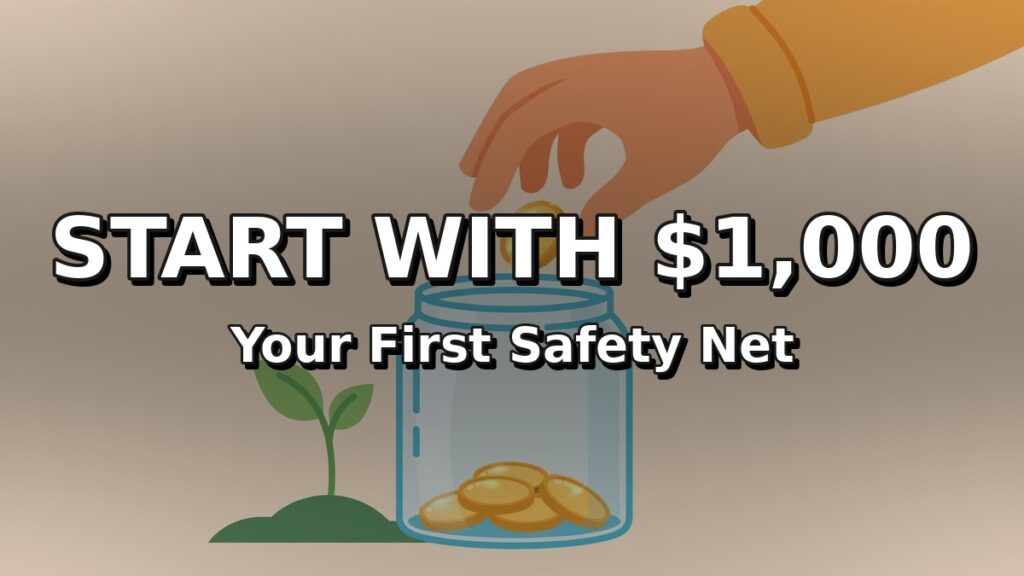
1. Start with a $1,000 mini-fund
Financial studies consistently show that having even $1,000 set aside dramatically reduces the chance of falling into high-interest debt. Treat this as sprint one. Sell something you do not use, pick up a weekend gig for a month, pause two subscriptions, redirect your next tax refund or bonus — do whatever it takes to hit $1,000 in 60-90 days.
2. Automate a fixed amount on payday
Once the mini-fund exists, set an automatic transfer for the day after each payday. Even $50-100 per paycheck adds up: $100 twice a month is $2,400 a year, quietly, without willpower. Increase the amount whenever your income rises — never let lifestyle inflation eat the raise first.
3. Funnel windfalls straight in
Tax refunds, cashback rewards, birthday money, sold furniture, a side-hustle payout — decide in advance that half of every windfall goes to the emergency fund until it is full. This one rule can cut your build time in half.
4. Shrink the target temporarily
Building the fund while carrying high-interest debt? Split your extra money: most toward the debt, a smaller slice toward the fund. Once the expensive debt is gone, redirect the full amount to savings. And remember — you can rebuild the fund after an emergency. Using it is not failure; that is literally what it is for.
A Worked Example: Building a $5,400 Fund in 16 Months
Here is the plan above running on real numbers. Take a renter whose monthly survival number — essentials only — is $1,800: rent $950, utilities $140, groceries $360, transport $150, insurance $120, and minimum debt payments $80. A three-month fund for this household is 3 × $1,800 = $5,400.
The engine is a $300 automatic transfer the day after payday. On top of that come windfalls, following the “half of every windfall” rule: $150 from selling unused items in month 2, $300 in month 8 (half of a $600 tax refund), and $200 in month 14 (half of a $400 work bonus).
No single month is heroic. Most months add exactly $300. But watch what the combination does: the $1,000 mini-fund is complete in month 3, the fund passes halfway in month 9, and the full three-month target is reached in month 16 — two months sooner than transfers alone would manage, purely because the windfalls were routed instead of spent. That is the whole system: a boring automatic transfer, plus a decision about windfalls made once, in advance.
| Checkpoint | Auto-transfers so far | Windfalls added so far | Fund total | Milestone |
|---|---|---|---|---|
| Month 3 | $900 | $150 | $1,050 | $1,000 mini-fund complete |
| Month 6 | $1,800 | $150 | $1,950 | One month of expenses covered |
| Month 9 | $2,700 | $450 | $3,150 | Past halfway |
| Month 12 | $3,600 | $450 | $4,050 | |
| Month 15 | $4,500 | $650 | $5,150 | |
| Month 16 | $4,800 | $650 | $5,450 | Three-month target ($5,400) reached |
The 2026 Reality Check
Two things make an emergency fund 2026 more important now than five years ago:
Prices are higher, so old targets are stale. If you set a $5,000 target in 2021 based on old expenses, recalculate with today’s rent, groceries, and insurance. A fund sized for 2021 prices buys noticeably less safety in 2026.
Income is less predictable for more people. Gig work, freelancing, and contract roles keep growing — and irregular income needs a bigger cushion, not a smaller one. If any part of your income varies month to month, lean toward the 6-month side of the range.
Recalculate your survival number once a year. It takes ten minutes and keeps your emergency fund 2026 honest.
What to Do After Your Emergency Fund 2026 Is Full
Hitting your target is a genuine milestone — celebrate it. Then redirect that automatic transfer:
- High-interest debt — anything above ~7% interest is costing you more than savings earn.
- Retirement investing — the money now works for decades instead of sitting idle.
- Other goals — a house deposit, a car replacement fund, education.
Keep the emergency fund topped up, though. After you use it, rebuilding it jumps back to priority one — before investing, before extra debt payments. The safety net comes first, always.
Should I build an emergency fund or pay off credit card debt first?
Do both, in sequence. Build the $1,000 mini-fund first — without it, the next surprise expense goes straight back onto the card. Then split your extra money: most of it toward the high-interest debt, a smaller slice to keep the fund growing. Once the expensive debt is gone, redirect everything to the fund until it is full.
My essential spending changes every month. How do I pick my survival number?
Average it. Add up the essentials from your last three bank statements — rent, utilities, groceries, transport, insurance, minimum payments — and divide by three. Then round the result up slightly. A survival number that is a little too high costs you a few extra weeks of saving; one that is too low fails you in the exact month you need it.
Your 7-Day Emergency Fund Starter Plan

- Today: Calculate your monthly survival number (essentials only).
- Tomorrow: Multiply by 3 — that is your target. Divide by 12 for a monthly pace.
- Day 3: Open a separate high-yield savings account if you do not have one.
- Day 4: Set up an automatic transfer for the day after payday.
- Day 5: List 3 things you can sell or pause to jump-start the first $1,000.
- Day 6: Write your emergency definition on paper and keep it where you will see it.
- Day 7: Make the first transfer, however small. The fund now exists.
One bad month should never be able to wreck five good years. Build your emergency fund 2026, and it cannot. For investor education resources, visit Investor.gov.
Keep Reading on Asmat Magazine:
- How to Create a Budget That Actually Works (The 50/30/20 Rule Explained)
- 10 Simple Ways to Save Money on a Low Income
- How to Get Out of Debt: Snowball vs Avalanche Method (2026)
Disclaimer: This article is for educational purposes only and is not financial advice. Everyone’s situation is different — consider speaking with a qualified financial advisor before making major financial decisions.