
Utility bills are the quiet leak in most household budgets. Electricity, heating, water, and internet add up to hundreds of dollars a month — and unlike rent, you can learn how to save money on utilities starting today, without moving house or giving up comfort. A $60 monthly saving is $720 a year. This guide walks through 14 practical ways that actually move the number on the bill.

Know Where Your Utility Money Actually Goes
You cannot cut what you have not measured. Before changing anything, pull up your last three bills — electricity, gas or heating, water, and internet — and write down the monthly average for each. Most households are surprised: heating and cooling usually take the biggest share, followed by water heating, appliances, and lighting. Knowing your split tells you where to aim first.
Do this in 20 minutes:
- List every utility and its average monthly cost. Include electricity, gas, water, sewerage, internet, and phone if it is bundled with your home costs.
- Check for fixed charges vs. usage charges. Every bill has a standing daily charge you cannot change, plus a usage charge you can. Focus your effort on usage.
- Look for seasonal spikes. A winter heating spike or a summer cooling spike points straight at your biggest saving opportunity.
- Compare with a similar household. Many suppliers show an average for homes like yours on the bill or in their app. If you are well above it, there is room to save.
Once you know the numbers, the tips below become a targeted plan. If you are rebuilding your budget, our guide to how to create a budget that actually works shows how to fit utility savings into it.
Cut Your Electricity Bill Without Living in the Dark — and Save Money on Utilities
Electricity is the easiest utility to trim because so much of it is wasted on things nobody is using.
- Switch every bulb to LED. LEDs use about 75% less energy than old incandescent bulbs and last far longer. Replacing the five bulbs you use most often can pay for itself within a year.
- Kill standby power. TVs, game consoles, printers, and chargers keep drawing power when they are off. A switched power strip lets you cut them all with one click at night.
- Run large appliances at full loads. A half-empty washing machine or dishwasher uses almost as much energy as a full one. Wait for a full load, and wash clothes on cold where the label allows.
- Check your fridge. Keep it between 37°F and 40°F, do not block its vents, and vacuum the coils once a year. An old second fridge in the garage can quietly cost $100 or more a year to run.
None of this requires sitting in the dark. It is about stopping energy you never notice — which is exactly why it works.
Heat and Cool Your Home for Less

Heating and cooling are usually the biggest utility cost of all, so even small changes here beat big changes elsewhere.
- Set the thermostat like you mean it. Dropping the heating by just 1°C in winter can cut heating costs by several percent, and most people do not notice the difference, especially overnight. A programmable thermostat does this automatically.
- Seal the leaks. Draughts around doors and windows are money blowing out of the house. Cheap draught strips, door sweeps, and sealant around window frames are among the highest-return fixes in any home.
- Use curtains as insulation. Open them on sunny winter days to let warmth in, close them at dusk to keep it in, and do the reverse in summer: keep sun-facing curtains closed during the hottest hours.
- Heat the rooms you use. Close vents or radiators in rooms you rarely enter, and use a fan to circulate warm air in winter. Heating an empty spare room all day is one of the most common wastes.
Use Less Water — and Pay Less for It
Water bills are smaller than energy bills, but they are also the easiest to cut without feeling any difference.
- Fix leaks fast. A dripping tap can waste thousands of gallons a year. Check toilets too: a silent leak there is often the biggest water waster in a home.
- Shorten showers by two minutes. That alone can save hundreds of gallons per person per month, plus the energy used to heat the water.
- Fit low-flow showerheads and tap aerators. They cost little, take minutes to install, and most people cannot tell the difference in pressure.
- Run the washing machine and dishwasher only when full, and choose shorter cycles where your machine offers them.
Lower Your Internet and Phone Bills
Internet and phone are utilities too, and they are the ones most people overpay for out of habit.
- Check what speed you actually need. Most households do fine on a mid-tier plan. If you are paying for gigabit speeds but mostly stream video and browse, you are paying for capacity you never use.
- Call your provider once a year. Ask what current deals exist for new customers, and whether a loyalty discount or a cheaper plan fits your usage.
- Review subscriptions tied to your bills. Streaming services, cloud storage, and app subscriptions that renew through your phone or internet account are easy to forget. Cancel what you have not used in the last month.
Pair this with our guide to 10 simple ways to save money on a low income.
Mistakes That Keep Your Utility Bills High
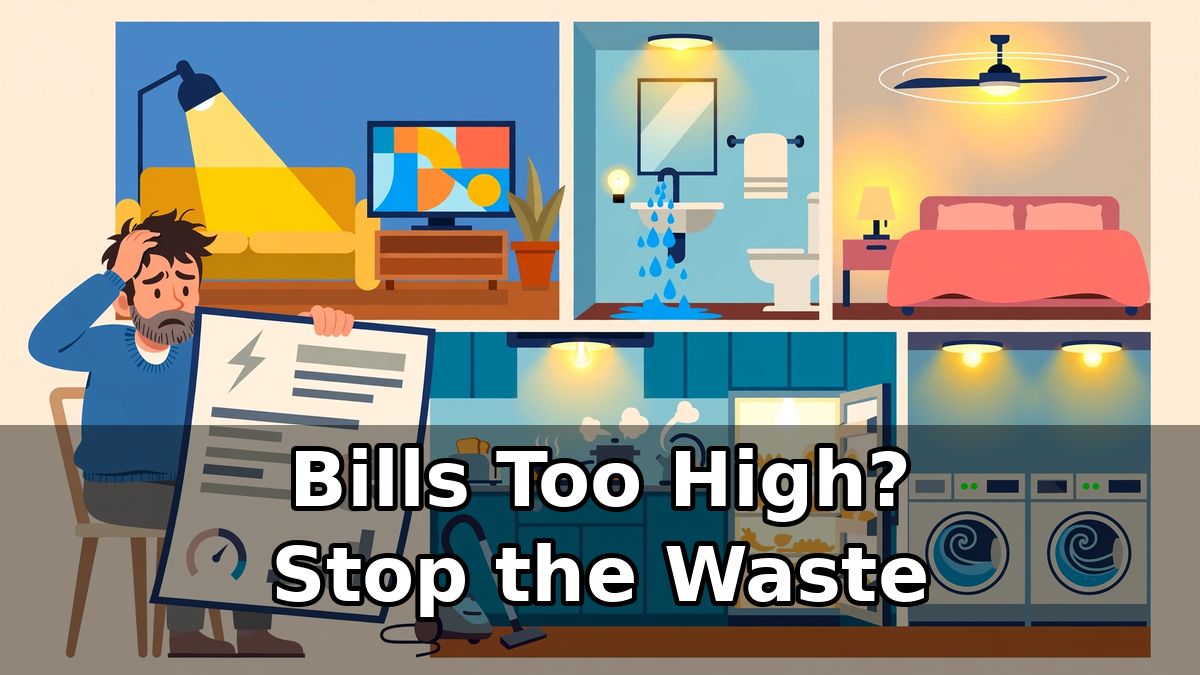
Most households overpay for avoidable reasons:
- Never comparing suppliers or plans. Energy markets change, and the plan that was cheapest two years ago may not be today. Compare at least once a year.
- Leaving everything on standby. It feels like nothing, but standby power across a whole house adds up to a real monthly cost.
- Heating or cooling an empty home. A home at full comfort temperature while everyone is at work is wasted energy.
- Ignoring the bill itself. Bills hide estimated readings, wrong tariffs, and charges for services you never ordered. Read yours for two minutes each month.
- Buying efficiency last. When an appliance dies, the cheapest replacement is rarely the cheapest to run.
- Trying to fix everything at once. Pick your biggest bill, fix that first, and bank the saving.
A steady utility saving also accelerates bigger goals. Our realistic $10,000 savings plan shows how $50–$75 a month freed from bills compounds into a serious target over a year.
Utility Saving Q&A
How much can I realistically save on utilities?
Most households can cut 10–20% without any lifestyle change — often $40–$80 a month — by fixing leaks, sealing draughts, switching bulbs, and comparing plans. Bigger wins come from heating and cooling changes.
Is a smart thermostat worth the cost?
For most homes, yes, if you are out during the day or your schedule varies. It pays for itself by heating and cooling only when needed, and many energy suppliers offer rebates.
Should I switch energy suppliers every year?
Compare every year, switch when the saving is real — usually at least $100 a year after fees. Do not switch for a tiny saving if it means losing a good fixed rate or paying an exit fee.
Do energy-saving gadgets actually work?
Some do — LED bulbs, smart thermostats, and low-flow showerheads are proven. Be sceptical of plug-in electricity saver boxes that promise huge cuts with no evidence; the U.S. Department of Energy’s energy-saving guidance is a reliable place to check what genuinely works.
What is the single best first step?
Read your last three bills and find your biggest cost. Fix that one first — usually heating, cooling, or an old appliance — and the rest of the list becomes much easier to prioritize.
Keep Reading
- How to Create a Budget That Actually Works (The 50/30/20 Rule Explained)
- 10 Simple Ways to Save Money on a Low Income
- How to Save Money on Rent: 12 Practical Tips for Beginners (2026 Guide)
- How to Save $10,000 in a Year: A Realistic Plan for Beginners (2026 Guide)
This article is for educational purposes only and is not financial advice. Utility prices, tariffs, and supplier rules vary by location and change over time — do your own research and consider speaking with a qualified professional before making financial decisions.