Every freelancer you admire started with zero clients, zero reviews, and zero proof it would work. The good news: you do not need a degree, a portfolio of past clients, or years of practice to start freelancing with no experience. You need one sellable skill, a simple way to find clients, and the discipline to keep showing up.
This guide walks you through the exact steps, in order — from choosing a service to landing your first paid project — so you can start freelancing with no experience with confidence.
What Freelancing Actually Is (and Why Beginners Have an Edge)
Freelancing means selling a service directly to clients instead of working as an employee. Writing, design, video editing, virtual assistance, bookkeeping, social media management — if a business will pay someone to do it, you can freelance it. It is one of the most accessible ways to start freelancing with no experience, because clients pay for results, not résumés.
Beginners actually have two hidden advantages: you are cheap (clients will take a chance on a lower rate), and you are motivated (you over-deliver because every early review matters). The main thing you lack — a track record — can be built in weeks, not years, using the methods below.
Set one honest expectation: the first gig is the hardest. After five completed projects, freelancing gets dramatically easier. Your job this month is not “build a career” — it is “get gig number one.”
Pick a Freelance Service You Can Sell Without Experience
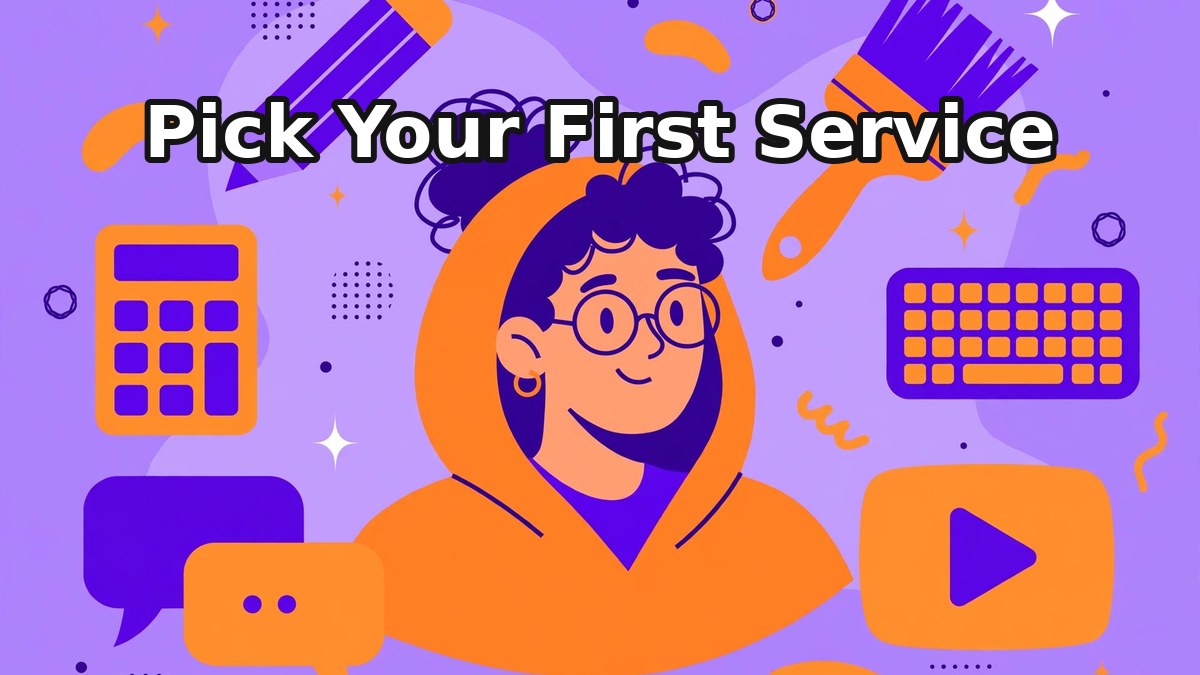
Do not start with “what am I passionate about?” Start with “what can I deliver decently this week?” Here are beginner-friendly services that need no credentials:
- Writing and editing. Blog posts, newsletters, product descriptions. If you write clearly, start here.
- Social media management. Small businesses need posts, replies, and scheduling — learn the basics free on YouTube.
- Virtual assistance. Email management, data entry, calendar handling, research. Organization is the skill.
- Canva design. Social graphics, presentations, simple logos. Canva’s free tier is enough to start.
- Video editing basics. Short-form clips for creators and businesses; CapCut is free and powerful.
- Bookkeeping. Small businesses pay for clean records; free tutorials cover the basics.
Pick ONE. Freelancers who offer everything convince nobody. You can add a second service after your first five clients. Mastering one service first is the fastest way to start freelancing with no experience.
7 Steps to Start Freelancing With No Experience
Follow these in order — each builds on the last.
Step 1: Build a Tiny Portfolio in 48 Hours
Clients will not ask for a résumé; they ask for proof. Create 2–3 sample pieces this weekend:
- A writer: three 500-word sample blog posts (publish them on a free Medium page).
- A designer: five Canva graphics in one niche (post them on a free Behance profile).
- A video editor: three edited reels made from free stock footage.
- A virtual assistant: a one-page “how I organize a client inbox” checklist plus a sample spreadsheet.
Label them “sample work” — honesty beats fakery. Two strong samples beat ten mediocre ones.
Step 2: Write a Clear One-Sentence Offer
Your offer is: “I help [type of client] get [result] through [service].” Examples:
- “I help real estate agents get more inquiries through short-form video editing.”
- “I help busy coaches save 5 hours a week through email and calendar management.”
Specificity wins clients. “I do graphic design” is invisible; “I design Instagram carousels for fitness coaches” is a business.
Step 3: Set Up Your Freelancer Profiles
Create profiles on two platforms maximum (plus one place you own, like a free portfolio site):
- Upwork — biggest general marketplace; filter for beginner-friendly, fixed-price jobs.
- Fiverr — package your service as a “gig” with a clear deliverable and turnaround.
- A portfolio page — Behance, Medium, or a simple free site so you own your proof.
Fill out every profile section completely. Profiles with photos, filled bios, and samples get dramatically more clicks than bare ones — most beginners skip this and wonder why nobody bites.
Step 4: Price Yourself to Get Hired (Then Raise Rates)
Your first goal is reviews, not riches. A simple beginner pricing ladder:
- Gigs 1–3: below-market rates or even a fixed-price trial — your payment is the review.
- Gigs 4–10: raise to the low end of the market range (check what others charge on Upwork and Fiverr).
- After 10+ five-star reviews: charge the market rate or above.
Fixed prices beat hourly rates for beginners — clients fear open-ended hourly bills. “I’ll edit 5 reels for $60, delivered in 3 days” converts better than “$12/hour.”
Step 5: Send 5 Proposals a Day for 30 Days
This is the unglamorous engine of freelancing. Five tailored proposals daily is the number that works for most beginners — it is enough volume to learn what lands, without burning out.
Every proposal follows the same 3-part formula:
- One line showing you read the job. (“I see your podcast needs weekly show notes — I write notes for two marketing podcasts now.”)
- One line of proof. (Link your best relevant sample — even if it is self-made.)
- One line with a concrete offer. (“I can deliver your first episode’s notes in 48 hours for $40.”)
Never copy-paste generic proposals. Clients can smell templates instantly. And always attach or link a sample — proposals with proof get opened far more often.
Step 6: Over-Deliver on Your First 5 Gigs
Your first clients are not just income — they are your marketing department. Deliver early, communicate clearly, and ask for a review the moment the job is done (not a week later). A short message works: “If you’re happy with the work, a review would mean a lot — it helps me grow.”
Respond fast, keep promises, and fix mistakes immediately. Reputation compounds: five 5-star reviews unlocks the higher-paying jobs.
Step 7: Turn One-Time Gigs Into Retainers
The cheapest client to get is the one you already have. When a gig goes well, offer the ongoing version: weekly content, monthly design hours, a package of 10 reels a month. Retainers smooth your income — freelancers with just two or three monthly retainers stop living gig-to-gig.
Track every project in a simple spreadsheet: client, rate, hours, payment date. Read the budget guide at https://asmatmagzine.site/how-to-create-a-budget-50-30-20-rule/ to give irregular freelance income a structure, and a starter emergency fund at https://asmatmagzine.site/emergency-fund-how-much-2026/ matters even more when paydays are unpredictable.
Where to Find Your First Freelance Clients

Platforms are the easiest start, but do not stop there. Pick one platform and one outreach channel to start freelancing with no experience this month.
- Upwork and Fiverr — best for the first 10 reviews; competition is real, so niche down.
- X (Twitter) and LinkedIn — post your samples, reply helpfully in your niche, and DM businesses that clearly need your service.
- Facebook groups and Reddit — niche communities (podcasters, coaches, Etsy sellers) post “looking for help” threads constantly.
- Your existing network — tell everyone what you do now. The first client of many freelancers is a friend of a friend.
- Cold outreach — find 20 businesses with a weak version of what you offer, send each a 3-line message with one sample attached. Expect 1–2 replies per 20 messages; that is normal.
How Much to Charge as a Beginner Freelancer
Realistic 2026 beginner ranges for common services. Use these numbers as a starting point when you start freelancing with no experience this year.
| Service | Starting rate | After 10+ reviews |
|---|---|---|
| Writing (per 1,000 words) | $20–$50 | $75–$150+ |
| Social media management (monthly) | $200–$400/client | $500–$1,500/client |
| Video editing (per short video) | $10–$30 | $40–$100+ |
| Virtual assistance (hourly) | $12–$20 | $25–$50 |
| Canva design (per graphic) | $10–$25 | $40–$80 |
These are starting points, not ceilings. Raise your rate every 3–5 clients until clients start pushing back — then you have found your market price.
5 Beginner Freelancing Mistakes to Avoid
- Waiting until you “feel ready.” You will never feel ready. Start with samples and small gigs — competence comes from client work, not preparation.
- Saying yes to everything. A project that pays $15 for 10 hours teaches you to undervalue yourself. Set a floor and hold it.
- No contract, no deposit. Even a simple email agreement (“$200, half upfront, delivery Friday”) prevents most payment drama. Never start without a deposit on larger projects.
- Ignoring taxes. In the US, freelance income is self-employment income — the IRS self-employment tax page at https://www.irs.gov/businesses/small-businesses-self-employed/self-employment-tax-social-security-and-medicare-taxes covers the basics. Set aside 25–30% of every payment.
- Quitting your job too early. Keep your job until freelancing reliably replaces your income for 3–6 months. Freelance income is lumpy; an emergency fund smooths the bumps.
Start Freelancing With No Experience: Quick Q&A
How long until I get my first client?
With 5 tailored proposals a day, most beginners land the first paid gig in 2–6 weeks. The proposal habit matters more than talent.
Do I need a business license to freelance?
For occasional freelance work, usually not at first. Check your city and state rules once income becomes consistent.
Is Upwork too competitive for beginners?
It is competitive but not closed. Niche down, write tailored proposals, and target newer job postings (under 10 proposals) — your reply stands out more there.
Can I freelance part-time while employed?
Yes — most freelancers start this way. Just check your employment contract for non-compete or moonlighting clauses first.
What is the fastest freelance service to learn?
Virtual assistance and social media management have the shortest learning curves — a focused weekend of free tutorials is often enough to take a first client.
You do not need permission to start freelancing with no experience — send your first five proposals this week, and you are already ahead of everyone still waiting to feel ready.
Keep Reading
- 15 Legit Side Hustles With No Money (2026 Guide)
- How to Create a Budget That Actually Works (The 50/30/20 Rule Explained)
- Emergency Fund: How Much Do You Really Need in 2026?
- How to Get Out of Debt: Snowball vs Avalanche Method (2026)
This article is for educational purposes only and is not financial advice. Do your own research and consider speaking with a qualified professional before making financial decisions.