Your savings account is probably losing you money every single year. Not because you are spending it — but because most regular bank accounts pay a miserable 0.01% interest while inflation quietly eats 2–3% of your balance’s buying power. A high-yield savings account (HYSA) is the simplest fix in all of personal finance: the same money, the same FDIC safety, but an interest rate that is often 10 to 100 times higher. In this guide, you will learn exactly how high yield savings accounts work, what rates look like in 2026, whether they are really safe, the catches to watch for, and a five-step process to pick the best one for your money.
What Is a High-Yield Savings Account?
A high-yield savings account is a normal savings account that pays a much higher interest rate — usually expressed as APY (annual percentage yield). It works exactly like the savings account you already have: you deposit money, earn interest, and withdraw whenever you need it. The difference is the number on the rate.
Why do some accounts pay so much more? The best rates come from online-only banks and fintechs. Without thousands of expensive branches to run, they can pass their savings to you as higher interest. A brick-and-mortar giant has to pay rent on every location — an online bank does not, so it can afford to pay you 4% while the big bank pays you 0.01%.
One important note: HYSA rates are variable. The bank can raise or lower the rate at any time, usually following the Federal Reserve’s rate moves. So today’s 4.50% could become 4.00% next quarter. That is normal and still vastly better than a traditional account — but do not treat the rate as locked in. (Locked rates belong to CDs, which we will compare below.)
How Much More Do High-Yield Savings Accounts Pay?
The gap is bigger than most people realize. In 2026, typical numbers look like this:
- Traditional big-bank savings: 0.01% to 0.05% APY
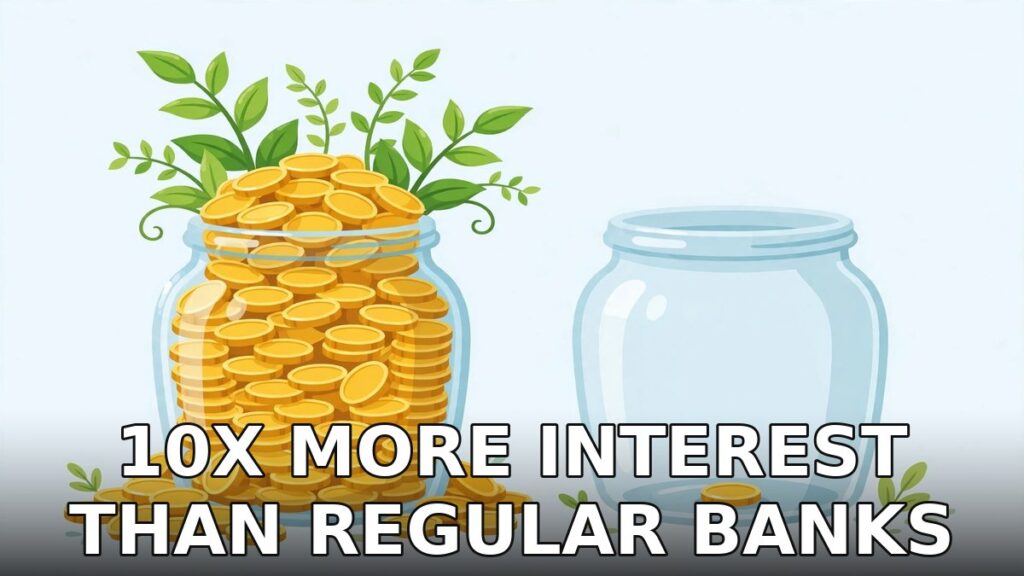
- High yield savings accounts: typically 4.00% to 5.00% APY
That is not a small upgrade. At 0.01%, a $10,000 balance earns $1 a year. At 4.50%, the same $10,000 earns $450 a year — for literally the same money, with the same FDIC insurance, in an account that took 15 minutes to open. Over five years, the difference on that $10,000 is roughly $2,200 in free money you either collect or hand back to your bank’s shareholders.
Put another way: if you have an emergency fund of $6,000 sitting in a regular savings account (and if you are not sure how big yours should be, read how much you really need in 2026), moving it to a 4.50% HYSA pays you about $270 a year instead of $0.60. That is the highest-return 15 minutes of your financial life.
Are High-Yield Savings Accounts Safe?

This is the question that stops most people, so let us answer it directly: yes, they are just as safe as your current bank account.
Most high yield savings accounts are offered by FDIC-insured banks — the exact same insurance that protects your checking account at a big bank. FDIC insurance covers up to $250,000 per depositor, per bank. A few HYSAs are offered by credit unions instead, which carry the equivalent NCUA insurance. If the institution goes under, your money is protected up to the limit.
Three things to verify before opening any account:
- FDIC or NCUA insurance. This should be stated on the account’s website, usually in the footer. If you cannot find it, do not open the account.
- No account minimums you cannot handle. The best HYSAs have no minimum balance and no minimum to open. Skip anything that requires a large opening deposit.
- No monthly fees. Legitimate HYSAs charge $0 monthly fees. If an account charges a fee, the interest is not really “high yield” anymore.
One more reassurance: the “online-only” part does not mean your money lives in the cloud. These are real banks with real charters, real insurance, and transfers that go through the same ACH network as every other bank. The only real difference is that you will not visit a branch — and honestly, when was the last time you did?
The Catch: 4 Things to Watch Out For
HYSAs are genuinely one of the best deals in personal finance, but they are not perfect. Know these four catches before you switch:
- Rates can drop. HYSA rates follow the Federal Reserve’s benchmark. When the Fed cuts rates, your APY will drift down too. It will still beat traditional accounts — the gap shrinks, it does not disappear.
- Transfer delays. Moving money from an HYSA to your checking account takes 1–3 business days through ACH. That is fine for an emergency fund (plan for it), but do not expect instant access for same-day bills.
- Teaser rates exist. Some banks advertise a sky-high rate that applies only to new customers for a few months, then quietly drops. Check the bank’s history of rates, not just today’s number — consistent 4%+ payers are better than one-month 6% wonders.
- It will not make you rich. A 4.50% APY on your emergency fund is fantastic relative to 0.01%, but it still barely beats inflation over time. HYSAs are for money you need safe and accessible — your emergency fund, short-term goals, money you are saving for a purchase. For long-term wealth, that money needs to be invested (see how to start investing with $100).
How to Pick the Best High-Yield Savings Account

Here is a five-step process that takes about 20 minutes:
Step 1: Shortlist 3–4 banks with 4%+ APY. Compare current rates on reputable roundups (Bankrate and NerdWallet both maintain updated lists). Note the rate, but do not choose on rate alone — steps 2–4 matter more.
Step 2: Confirm FDIC insurance. Verify the bank is FDIC-insured, either directly or through a partner bank. This is non-negotiable.
Step 3: Check fees and minimums. The right answer is $0 monthly fee and $0 minimum to open. If an account has either, cross it off — a “high” rate with fees is a marketing trick.
Step 4: Read the fine print on the rate. Is it available to everyone, or only for the first 90 days? Are there balance tiers where the rate drops below a certain amount? The best accounts pay the advertised rate on your entire balance from dollar one.
Step 5: Open the account and set up the transfer link. Opening takes 10–15 minutes with an ID and your existing bank details. Link your checking account, move your emergency fund over in one transfer (or a couple, if you want to be cautious), and set up an automatic monthly transfer so your savings grow on their own.
A practical tip: keep your everyday checking account wherever it is convenient, and treat the HYSA as your savings home. The 1–3 day transfer delay is actually a feature — it creates a small buffer that stops impulse spending, which is exactly what an emergency fund needs.
High-Yield Savings Account vs Other Options
How does an HYSA compare with the alternatives for your safe money?
| Option | Typical APY (2026) | FDIC insured | Withdraw anytime |
|---|---|---|---|
| High-yield savings account | 4.00–5.00% | Yes | Yes |
| Traditional savings account | 0.01–0.05% | Yes | Yes |
| Money market account | 3.50–4.50% | Yes | Yes (some limits) |
| Certificate of deposit (CD) | 4.00–5.00% | Yes | No (penalty) |
| Checking account | 0.01% or less | Yes | Yes |
For most beginners, the HYSA is the sweet spot: the best rate you can get without locking your money up. CDs pay slightly more in some cases but penalize early withdrawals, which makes them a poor home for an emergency fund. Money market accounts are fine but often come with higher minimums. And traditional savings accounts are — frankly — a rounding error with a login button.
High-Yield Savings Accounts: Quick Q&A
What is a high-yield savings account in simple terms? A regular savings account with a much higher interest rate — typically 4–5% APY instead of 0.01%. Same FDIC safety, same easy access, but your money actually grows.
Are high yield savings accounts really safe? Yes, when they are FDIC- or NCUA-insured — which the legitimate ones are. Your money is protected up to $250,000 per depositor, per bank, exactly like a traditional account.
How much can I earn in a high-yield savings account? At 4.50% APY, $10,000 earns about $450 a year and $1,000 earns about $45. Use the Rule of 72 from our compound interest guide for a quick estimate of how any balance grows.
Can I lose money in a high-yield savings account? You cannot lose your deposits in an FDIC-insured account. The only real risk is inflation quietly eroding your buying power if your rate ever dips below the inflation rate — which is why you should review your rate once or twice a year.
How fast can I get my money out? Withdrawals are free and unlimited, but ACH transfers take 1–3 business days to reach your checking account. Some banks also offer ATM cards for faster access to smaller amounts.
Keep Reading
- Emergency Fund: How Much Do You Really Need in 2026?
- What Is Compound Interest? (Explained With Real Examples)
- Index Funds vs Individual Stocks: What’s Better for Beginners?
- How to Start Investing With $100 (Beginner’s Guide)
This article is for educational purposes only and is not financial advice. Do your own research and consider speaking with a qualified professional before making financial decisions.