
If you have ever wondered what is compound interest, this guide explains it in plain English, shows you real numbers so you can see exactly how it works, and gives you a practical plan to put it to work for your money instead of against it. Compound interest is the single most important concept in personal finance — and most people learn it far too late. It is the reason a small monthly investment in your twenties can turn into serious money by retirement, and it is also the reason credit card debt snowballs out of control. The math behind it is simple, but the results feel like magic.
Compound Interest vs Simple Interest
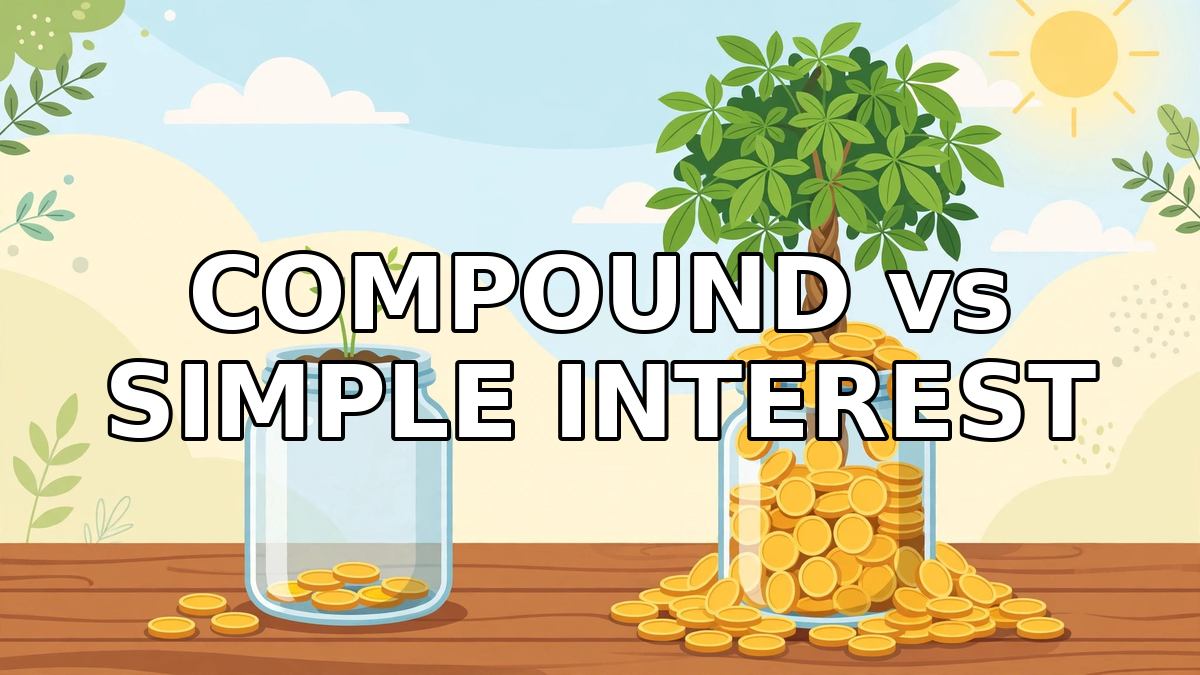
Here is the difference that changes everything. Simple interest pays you a return only on the money you originally put in. Compound interest pays you a return on your original money plus every bit of interest you have already earned — so your growth speeds up over time.
Imagine you invest $1,000 at 10% per year and never touch it:
| Year | Simple interest (10% of $1,000) | Compound interest (10% of balance) |
|---|---|---|
| Year 1 | $1,100 | $1,100 |
| Year 2 | $1,200 | $1,210 |
| Year 5 | $1,500 | $1,611 |
| Year 10 | $2,000 | $2,594 |
| Year 20 | $3,000 | $6,727 |
| Year 30 | $4,000 | $17,449 |
Notice how the gap explodes over time. After 10 years, compounding gets you roughly 30% more. After 30 years, it gets you more than four times as much. That acceleration is the whole game: early on, compounding looks boring; later, it does most of the heavy lifting. In the 30-year example above, you only ever contributed $1,000 — compounding created the other $16,449.
The Compound Interest Formula (the Simple Version)
You do not need to be a math person. The formula is just this:
Final amount = Starting amount × (1 + rate) ^ years
So $1,000 at 10% for 30 years = 1,000 × (1.10)³⁰ ≈ $17,449. You will never calculate this by hand — free online calculators (the SEC’s investor.gov compound interest calculator is a good one) do it instantly. What matters is understanding the three levers inside that formula:
1. The starting amount. More money in = more money out. Obvious, but it is the least powerful lever for most beginners, because…
2. The rate of return. A higher rate compounds dramatically faster. Earning 8% instead of 4% does not double your result — over 30 years, it more than quadruples it. This is why keeping investment fees low matters so much: every 1% in fees is 1% less compounding.
3. Time — the lever beginners underestimate most. Time is the superpower. An extra ten years of compounding can matter more than doubling your monthly contribution. This is why “I will start investing later when I earn more” is the most expensive sentence in personal finance.
There is also a handy shortcut called the Rule of 72: divide 72 by your annual return and you get roughly how many years it takes your money to double. At 8%, money doubles every 9 years (72 ÷ 8). At 4%, it takes 18 years. One number, no calculator, and it works for savings, investments — and, as you will see next, debt.
Real Examples: The Power of Starting Early

Here is the example that converts more beginners than any other. Meet two friends who each invest $200 a month ($2,400 a year) and earn an average 8% annual return.
Alex starts at age 22 and invests until 62 — 40 years, contributing $96,000 total. Compound interest turns it into roughly $622,000.
Ben starts at age 32 and invests until 62 — 30 years, contributing $72,000 total. His money grows to roughly $272,000.
Alex contributed just $24,000 more than Ben. But he ends up with about $350,000 more — more than double. That extra $350,000 is pure compounding: it is what ten extra years at the beginning are worth. Every year you wait, you are not losing one year of contributions — you are losing the most powerful years of growth, the ones at the end of the curve when the snowball is biggest.
The lesson is not “invest a lot.” Both friends invested the same modest $200 a month. The lesson is start now, even small. If you have not started yet, our guide on how to start investing with $100 shows exactly how to make that first move this week.
The Dark Side: Compound Interest on Debt
Compounding does not care whose side it is on. Everything you just read also applies to the money you owe — only now, you are the one paying the growth.
Credit cards charge 20–25% APR, and that interest compounds monthly. A $5,000 balance at 22% where you pay only $150 a month takes roughly five years to clear — and you pay over $3,000 in interest on top of the original $5,000. More than a third of every dollar you hand over is just feeding the compounding machine working against you.
This is why getting out of high-interest debt is almost always a better “investment” than anything in the stock market: paying off a 22% credit card is a guaranteed 22% return, and no legal investment offers that. If you are carrying balances, read our breakdown of the snowball vs avalanche debt payoff methods — the avalanche method is specifically designed to kill the highest-compounding debt first.
One more place compounding bites: inflation. Prices rising 3% a year means money sitting in a 0% checking account is negatively compounding — losing about 3% of its buying power every year. That is why your emergency fund belongs in a high-yield account (see how much you really need saved in 2026), not under a mattress.
How to Make Compound Interest Work for You

Knowing the concept is worthless without action. Here is the plan:
- Start today, even with $50. As Alex and Ben proved, time beats amount. A small automatic investment you start this week will outperform a large one you start “someday.”
- Automate your contributions. Set up a monthly transfer into your investment account the day after payday. Automation removes willpower from the equation, and consistent contributions feed the compounding engine every single month.
- Reinvest everything. Turn on dividend reinvestment in your brokerage so every payout buys more shares, which earn their own payouts. This is compounding in its purest form — do not let dividends sit in cash.
- Keep fees low. A fund charging 1% instead of 0.1% does not cost you 0.9% once — it costs you 0.9% compounded every year for decades. Low-cost index funds (compare them in our index funds vs individual stocks guide) protect your compounding rate.
- Increase contributions as income grows. Every raise is a chance to raise your monthly investment before lifestyle creep spends it. Even an extra $50 a month compounds into tens of thousands over a few decades.
- Stay invested through downturns. Markets fall; that is normal. Selling in a panic locks in losses and — worse — resets your compounding clock. The investors who win are the ones who keep contributing while everyone else is scared.
Compound Interest: Quick Q&A
What is compound interest in simple terms?
It is earning interest on your interest. Each period, your returns are added to your balance, and the next period’s returns are calculated on the bigger balance — so growth accelerates over time.
How is compound interest different from simple interest?
Simple interest pays only on the original amount, growing in a straight line. Compound interest pays on the original amount plus all past earnings, growing in a curve that gets steeper every year.
What is the Rule of 72?
Divide 72 by your annual interest rate to estimate how many years your money takes to double. At 8%, money doubles about every 9 years; at 12%, about every 6.
Can compound interest make me rich?
It can build serious wealth, but it needs two ingredients: time (decades) and consistent contributions. Nobody gets rich from compounding in two years — but a disciplined investor over 30–40 years absolutely can reach six or seven figures from modest monthly amounts.
Is compound interest good or bad?
Both. It is the greatest wealth-building force in finance when it works on your savings and investments — and the most destructive force when it works on high-interest debt. Your only job is to make sure you are on the right side of it.
Keep Reading
- How to Start Investing With $100 (Beginner’s Guide)
- Index Funds vs Individual Stocks: What’s Better for Beginners?
- Emergency Fund: How Much Do You Really Need in 2026?
- How to Get Out of Debt: Snowball vs Avalanche Method (2026)
This article is for educational purposes only and is not financial advice. Do your own research and consider speaking with a qualified professional before making financial decisions.